


How to Perform Under Pressure: 5 Steps to Peak Performance and Flow


How do you perform at your best when the stakes are high, the outcome is uncertain, and fear gets loud?
Start by recognising what you fear, understanding your patterns, taking one deliberate action, building the capacity to continue and reconnecting with purpose. These five practices form the journey through my PeakFlow Method™: Fear, Awareness, Courage, Resilience, and Joy & Love.
I developed this framework through business psychology, leadership consulting, coaching and my own experiences in extreme swimming. It brings together four pillars—mental, emotional, physical and spiritual—to help people pursue meaningful performance while caring for the person behind the results.
The spiritual pillar means purpose, values and connection to something meaningful. It does not require a religious belief.
What is the difference between peak performance and flow?
Peak performance describes performing at your best in a particular context. Flow describes deep absorption in an activity, where attention is focused and action feels connected.
They can overlap, but they are not identical. You can perform well through deliberate effort without experiencing flow. You can also feel absorbed in an activity without producing your best result.
Research has found an association between flow and performance, while leaving questions about cause and effect open. Common conditions associated with flow include clear goals, useful feedback and a challenge that fits your skills.
In my methodology, PeakFlow describes a broader aspiration: reaching your personally meaningful peak with focus, alignment and fulfilment. It is my coaching framework, distinct from the psychological definition of a flow state.
What extreme swimming taught me about pressure
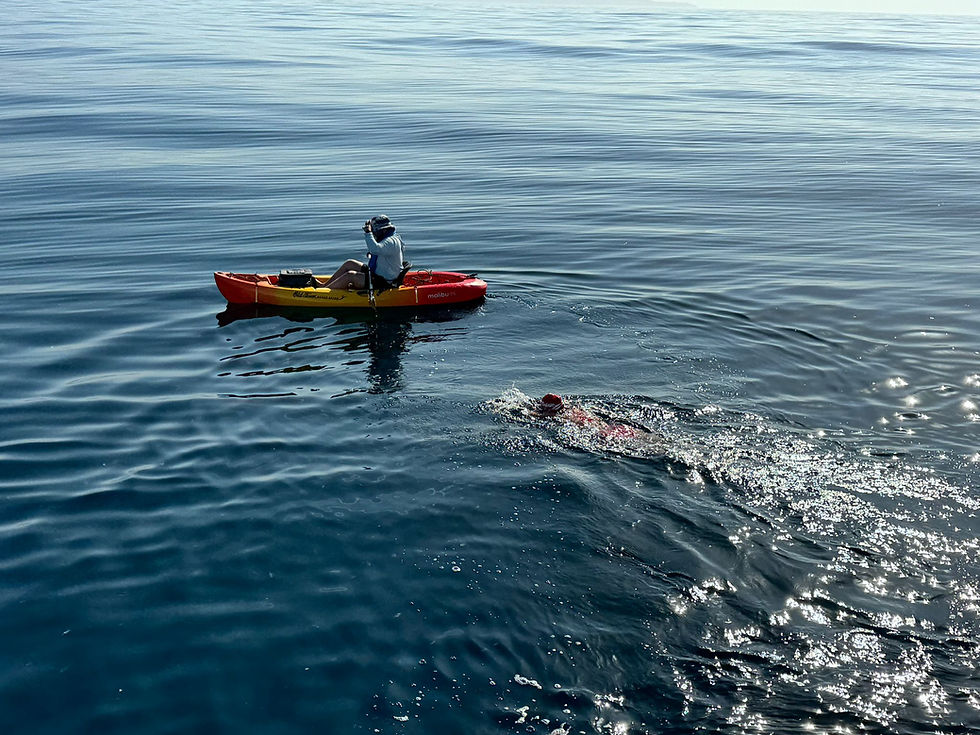
During my English Channel crossing, I could not control the sea. I could prepare, respond to changing conditions and return my attention to the next stroke.
That distinction matters in leadership too. A difficult conversation, a transformation project or an uncertain business decision can make the whole future feel urgent at once.
Preparation gives you resources. Awareness helps you recognise what is happening. Courage lets you act. Resilience helps you adapt and continue.
Here is how to practise that journey.
Step 1: Recognise fear — the Fear Zone
Fear may appear as procrastination, perfectionism, defensiveness or the need to control every detail. Before trying to overcome it, identify it.
Ask yourself: What am I afraid will happen—and what needs preparation or protection?
Write down the situation, the feared outcome and one practical response. If you are avoiding a presentation because you fear difficult questions, prepare for those questions and rehearse with someone you trust.
Fear can point towards a growth opportunity. It can also point towards a real risk. Learning to distinguish the two is part of responsible performance.

Step 2: Build clarity — the Awareness Zone
Awareness helps you separate the situation from the story you are telling yourself about it.
Before a challenging meeting, pause and ask:
What do I know, and what am I assuming?
What am I feeling?
What is happening in my body?
What matters most in how I respond?
These questions connect with the four pillars: mental clarity, emotional awareness, physical readiness and spiritual alignment with purpose.
Then define one concrete goal. “I need to impress everyone” is hard to act on. “I want the team to understand the decision and agree on the next action” gives you direction.
Step 3: Take a deliberate action — the Courage Zone
Courage means moving forward with preparation while uncertainty remains.
Ask yourself: What would my courageous version start or stop doing today?
Choose a manageable action: ask the question you have avoided, request feedback, rehearse the opening of your talk or name an unrealistic deadline.
For leaders, courage may mean admitting that you do not yet have an answer and inviting others to help find it. Choose a stretch you can learn from, with appropriate support.
Step 4: Build the capacity to continue — the Resilience Zone
Courage gets you out of your comfort zone. Resilience helps you stay engaged long enough to learn and transform.
Resilience involves adapting, recovering and asking for support. Sometimes continuing means changing the plan or setting a boundary.
After a difficult moment, review three questions:
What worked?
What needs to change?
What support or recovery do I need before the next attempt?
In teams, make this review a regular practice. Discussing setbacks without blame makes it easier to turn experience into useful learning.
Step 5: Reconnect with meaning — the Joy & Love Zone
The final zone asks what makes your performance worth sustaining.
Joy includes curiosity, enjoyment and a sense of being alive in what you do. Love includes care for yourself, other people and the contribution you want to make.
Ask yourself: What would meaningful success look like for me—and who benefits from it?
Then create conditions that support focused engagement: choose one clear task, reduce avoidable interruptions, seek useful feedback and adjust the challenge to your current capabilities.
You can't force or guarantee flow. You can create better conditions for it and notice what helps you return to focused, meaningful work.
A five-minute practice before a high-pressure moment
Use these five prompts before your next presentation, meeting or important decision:
Fear: What am I worried about?
Awareness: What is true, what am I assuming and what matters?
Courage: What is the next useful action?
Resilience: What will help me adapt if it becomes difficult?
Joy & Love: What meaningful contribution do I want to make?
These prompts are a way to begin practising the framework. They are not a promise of instant transformation or a guaranteed flow state.
You may return to earlier zones as a new challenge emerges. That is part of the learning process.
The next time pressure rises, give yourself a practical starting point: recognise the fear, find clarity and take one deliberate step.
Explore the PeakFlow Method™ and free assessment, or discover the Out of Comfort Zone bootcamp to practise these tools with others.
Ready to Step Outside Your Comfort Zone?
There are only two weeks left until the Out of Comfort Zone Bootcamp at Lake Zurich on 22 November 2026.
Join Deniz Kayadelen for an immersive experience designed to help you face your fears, build resilience, strengthen your mindset and discover what you're truly capable of.
Step away from your everyday routine, challenge your perceived limits and take the next step towards your personal peak performance.
Time is running out. Secure your place today!
Your next breakthrough starts outside your comfort zone.
Questions and answers
How can I perform better under pressure at work?
Prepare for the task, define a clear objective and identify what you can influence. Use the five-zone prompts to recognise fear, examine assumptions, choose an action, plan support and connect with purpose.
What are the five zones of the PeakFlow Method™?
The five zones are Fear, Awareness, Courage, Resilience, and Joy & Love. Deniz Kayadelen’s framework uses them to explore the journey from fear towards meaningful, sustainable performance.
What are the four pillars of PeakFlow?
The pillars are Mental, Emotional, Physical and Spiritual. They address thinking and focus, feelings and responses, energy and recovery, and purpose and values.
How do I create conditions for flow at work?
Choose a clear task, reduce interruptions, establish useful feedback and work at a challenge level that stretches your skills without overwhelming you. These conditions may support flow, but do not guarantee it.
Do I need to eliminate fear before taking action?
No. You can take a prepared, proportionate action while feeling fear. First assess whether the fear signals a real risk, a preparation gap or an assumption that needs testing.
How can leaders use this framework with their teams?
Invite people to name concerns, clarify goals, choose manageable experiments and review what they learn. Provide resources, realistic expectations and space for recovery alongside individual development.
Is the PeakFlow Method™ scientifically validated?
It is a practitioner-developed framework drawing on business psychology, coaching and lived experience. Research on flow supports some underlying concepts; that research does not establish that the complete five-zone PeakFlow Method™ has been independently validated.
Does PeakFlow require cold-water swimming?
No. You can practise reflection, goal-setting, courageous action and learning reviews in everyday work. Cold-water experiences are an optional element of some programmes.
About the author
Deniz Kayadelen is a business psychologist, six-time ice swimming world champion, Guinness World Record holder and founder of Out of Comfort Zone. She created the PeakFlow Method™ and works with leaders and teams through keynotes, coaching and experiential development programmes.


So helpful!! Will check the bootcamp!